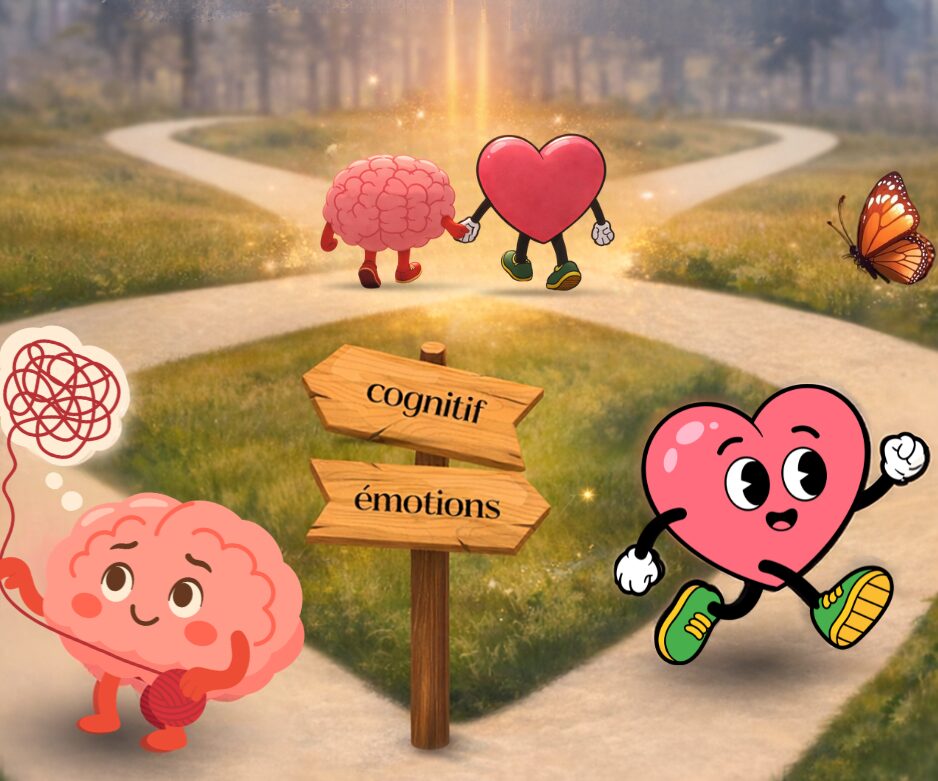
Have you ever noticed that seemingly very different issues can share a common root? That’s where the concept of a transdiagnostic factor comes in.
A transdiagnostic factor is a shared element that contributes to the development and persistence of various psychological disorders or difficulties. In many cases, that shared factor is a deficit in emotional skills.
Consider the following situations:
- Difficulty finding one’s path
- Struggles with self-assertion
- Recurring anger outbursts
- Feeling stuck in an unsatisfying career or relationship
- Chronic procrastination
- Self-esteem issues
- Recurring psychosomatic symptoms
- Recurring relationship conflicts, whether with a partner or colleagues
- Recurring burnout
- …
Although these issues seem unrelated, they often share a common root: difficulties in one or more emotional skills.
Emotional skills refer to the ability to identify, understand, use, express, and regulate one’s own emotions and those of others. Together, these skills form what’s more commonly known as “emotional intelligence,” and they play a crucial role in many areas of life, which explains their transdiagnostic nature.
Over the past few weeks, we’ve shared about a dozen case studies on our LinkedIn page, covering issues as varied as the ones listed above, each one showing which emotional skill(s) were lacking, what was worked on, and what results the patient or client saw. You can find them by clicking the link at the bottom of this email.
Why does this matter in practice?
By better understanding emotional skills, and above all the best way to develop them, we can:
- Identify the underlying source of many difficulties more quickly
- Address several issues at once by focusing on this shared factor
- Offer preventive tools to help avoid future difficulties
Want to learn more? Discover our training programs on this topic (available in French).
A few references
Mikolajczak, M., Quoidbach, J., Kotsou, I., & Nélis, D. (2023). Les compétences émotionnelles. Paris : Dunod.
*Kotsou, I., Nelis, D., Grégoire, J., & Mikolajczak, M. (2011). Emotional plasticity: conditions and effects of improving emotional competence in adulthood. Journal of applied psychology, 96(4), 827.
*Nelis, D., Kotsou, I., Quoidbach, J., Hansenne, M., Weytens, F., Dupuis, P., & Mikolajczak, M. (2011). Increasing emotional competence improves psychological and physical well-being, social relationships, and employability. Emotion, 11(2), 354.
By Moïra Mikolajczak, PhD in Psychology and lecturer at UClouvain